
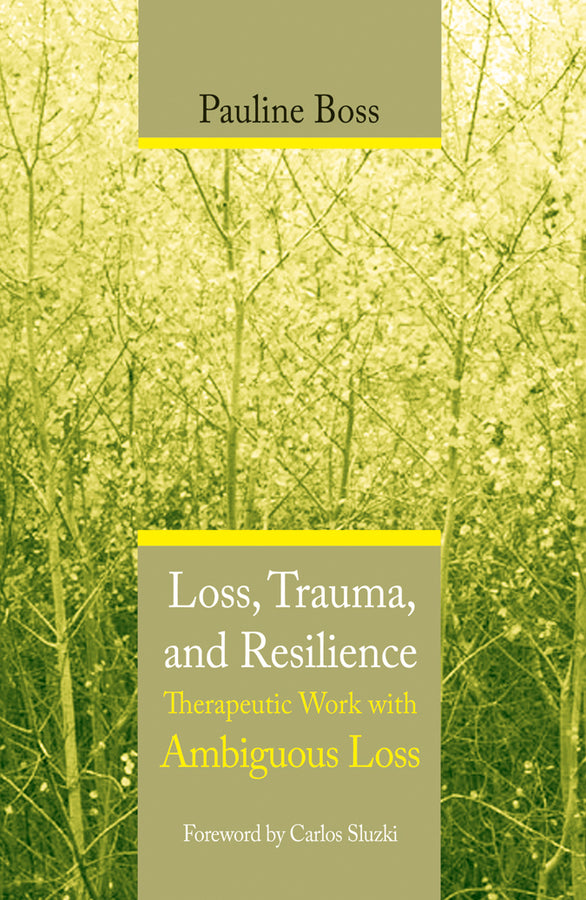

Description
Condition: BRAND NEW
ISBN: 9780393704495
Year: 2010
Publisher: W W Norton & Company
Pages: 280
Description:
All losses are touched with ambiguity. Yet those who suffer losses without finality bear a particular burden. Whether it is the experience of caring for a parent in the grip of Alzheimer? or waiting to learn the fate of a spouse gone missing in a disastrous event, the loss is disastrously coupled with a lack of closure. Bereft of rituals and social support, persons who experience such ambiguous losses find it hard to understand their situation, difficult to cope, and almost impossible to move ahead with their lives.
In Loss, Trauma, and Resilience, Boss, the principal theorist of the concept of ambiguous loss, offers new concepts and clinical practices for addressing this critical psychological experience that, in one form or another, touches all of our experiences of loss.
Boss draws on research and extensive clinical experience working with families in order to frame a powerful but flexible therapeutic approach. The fundamental goal is to guide readers in the task of building resilience in clients who face of the trauma of loss without resolution.
In Part I readers are introduced to the concept of ambiguous loss and shown how such losses relate to concepts of the family, definitions of trauma, and capacities for resilience. Over the course of these first three chapters Boss updates and expands her earlier understanding of ambiguous loss in a way that not only refines the character of the phenomenon but relates the phenomenon to other critical psychological and therapeutic categories.
In Part II Boss leads readers through the various aspects of and target points for working with those suffering ambiguous loss. From meaning to mastery,
ISBN: 9780393704495
Year: 2010
Publisher: W W Norton & Company
Pages: 280
Description:
All losses are touched with ambiguity. Yet those who suffer losses without finality bear a particular burden. Whether it is the experience of caring for a parent in the grip of Alzheimer? or waiting to learn the fate of a spouse gone missing in a disastrous event, the loss is disastrously coupled with a lack of closure. Bereft of rituals and social support, persons who experience such ambiguous losses find it hard to understand their situation, difficult to cope, and almost impossible to move ahead with their lives.
In Loss, Trauma, and Resilience, Boss, the principal theorist of the concept of ambiguous loss, offers new concepts and clinical practices for addressing this critical psychological experience that, in one form or another, touches all of our experiences of loss.
Boss draws on research and extensive clinical experience working with families in order to frame a powerful but flexible therapeutic approach. The fundamental goal is to guide readers in the task of building resilience in clients who face of the trauma of loss without resolution.
In Part I readers are introduced to the concept of ambiguous loss and shown how such losses relate to concepts of the family, definitions of trauma, and capacities for resilience. Over the course of these first three chapters Boss updates and expands her earlier understanding of ambiguous loss in a way that not only refines the character of the phenomenon but relates the phenomenon to other critical psychological and therapeutic categories.
In Part II Boss leads readers through the various aspects of and target points for working with those suffering ambiguous loss. From meaning to mastery,