
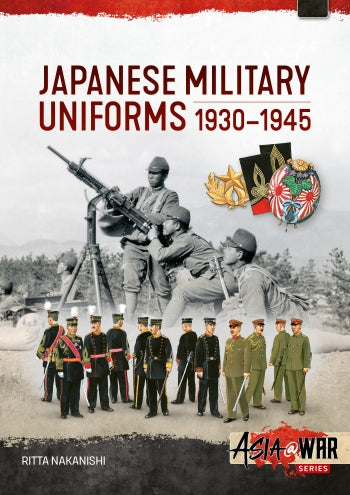

Description
Japanese Military Uniforms 1930-1945
For much of the twentieth century, the uniforms of Japan's armed forces were poorly understood outside Japan, often reduced to stereotypes or treated as a marginal subject within military history. Japanese Military Uniforms 1930 1945 decisively corrects that imbalance. This volume offers the most comprehensive, accurate, and visually precise study of Imperial Japanese Army and Navy uniforms ever published in English. Covering the critical period from the early Showa era through to Japan's defeat in 1945, the book documents in extraordinary detail the full range of uniforms worn by officers, non-commissioned officers, and enlisted men. Every major branch is examined: infantry, cavalry, armoured troops, artillery, engineers, military police, airborne and special forces, as well as the Imperial Guard. The Imperial Japanese Navy is treated with equal thoroughness, including aviation personnel, naval landing forces, specialist branches, and training establishments. Seasonal dress, tropical and winter uniforms, work dress, ceremonial dress, and specialist clothing for extreme environments are all fully illustrated and explained. What sets this edition apart is not only its visual authority, but also its textual completeness.
For much of the twentieth century, the uniforms of Japan's armed forces were poorly understood outside Japan, often reduced to stereotypes or treated as a marginal subject within military history. Japanese Military Uniforms 1930 1945 decisively corrects that imbalance. This volume offers the most comprehensive, accurate, and visually precise study of Imperial Japanese Army and Navy uniforms ever published in English. Covering the critical period from the early Showa era through to Japan's defeat in 1945, the book documents in extraordinary detail the full range of uniforms worn by officers, non-commissioned officers, and enlisted men. Every major branch is examined: infantry, cavalry, armoured troops, artillery, engineers, military police, airborne and special forces, as well as the Imperial Guard. The Imperial Japanese Navy is treated with equal thoroughness, including aviation personnel, naval landing forces, specialist branches, and training establishments. Seasonal dress, tropical and winter uniforms, work dress, ceremonial dress, and specialist clothing for extreme environments are all fully illustrated and explained. What sets this edition apart is not only its visual authority, but also its textual completeness.